

critical
hydrogen
Dictionary
The hydrogen transition is surrounded by technical language and political promises that often make projects like H2Med seem natural and unquestionable. This dictionary exists to make key terms understandable, uncover the realities behind the rhetoric, and support critical discussion.
It is for communities, activists, journalists, researchers, and everyone who wants to know what is being built in the name of the green transition. Use it to explore concepts, infrastructures, and conflicts, and to better understand who benefits and who carries the social and ecological costs.
Core Concepts
Energy colonialism describes how energy systems reproduce relations of domination through the control of land, labour, resources, infrastructure, and political decision making. Historically, this has been visible in imperial extraction from colonised territories whose energy and raw materials fuelled industrial centres elsewhere. The concept reminds us that energy systems are never neutral. They are shaped by power.
Today these dynamics continue through fossil fuels, mining, mega dams, renewable energy zones, and hydrogen corridors. Benefits such as profits, industrial growth, and energy security are often concentrated in powerful states, metropolitan centres, and large corporations, while environmental damage and social disruption are displaced onto other territories.
These patterns are especially visible between the Global North and Global South, where colonial histories still shape trade, finance, and infrastructure. But similar centre-periphery logics can also appear within the Global North itself. Rural regions, islands, and economically marginalised territories may be treated as spaces for extraction, transit, and sacrifice in the name of national or European progress.
Calling an energy project green does not make it just. If communities lose control over land, water, livelihoods, or democratic decision making, colonial logics remain.
Academic literature: Batel 2022; Batel and Devine-Wright 2017; Müller 2024; Sánchez Contreras et al. 2023; Sánchez Contreras et al. 2024; Sánchez Contreras and Matarán Ruiz 2025; Banks and Schwartz 2023; Dunlap 2024; Bhambra and Newell 2023; Tuck and Yang 2012
Energy colonialism is often discussed between North and South, but similar dynamics can also appear within Europe. Peripheral regions are turned into spaces for extraction, infrastructure, and sacrifice so that industrial and urban centres can secure energy and industrial growth.
This can mean wind parks without local consent, water intensive hydrogen projects, pipelines crossing rural territories, or landscapes reshaped for outside interests. Benefits are frequently exported while local communities face disruption, pressure on resources, and limited democratic control. On the Iberian Peninsula communities in regions like Extremadura and Zamora are facing what they call the ‘third wave on energy colonialism’. After huge hydropower developments in the first half of the 20th century, several nuclear plants followed in the second half. Already now Extremadura produces six times the amount of energy it consumes. Large-scale construction of renewable energy for export to northern Europe and the industrial centres in Spain.
The green transition must not reproduce internal colonialism between centres and peripheries under a new name.
Academic literature: Batel 2022; Sánchez Contreras et al. 2023; Sánchez Contreras et al. 2024; Müller 2024; Dunlap 2024; Banks and Schwartz 2023
Green extractivism describes the expansion of resource extraction and territorial appropriation in the name of climate action. Land, water, minerals, forests, public funds, and energy capacity are redirected to build supposedly sustainable economies while many old inequalities remain untouched.
Unlike conventional extractivism, green extractivism is justified through the language of decarbonisation, innovation, and net zero. Governments and corporations present new mines, industrial parks, mega solar fields, hydrogen pipelines, or port expansions as necessary for the planet. This creates the impression that resistance is anti-environmental, even when communities are defending ecosystems and democratic rights.
In practice, many green projects rely on familiar patterns: concentration of ownership, public subsidies for private actors, externalisation of ecological costs, and the sacrifice of peripheral territories. Regions with sun, wind, water, or available land are framed as empty opportunity zones rather than lived landscapes.
The problem is not renewable energy itself. The problem is using the climate crisis to deepen extractive models instead of transforming them.
Academic literature: Acosta 2013; Bruna 2021; Dunlap, Verweijen, and Tornel 2024; Batel 2022; Müller 2024; Fitzmaurice 2007; Zografos and Robbins 2020
Infrastructures and Technologies
Green hydrogen is hydrogen produced through electrolysis using electricity from renewable sources such as wind or solar power. It is promoted as a clean fuel for sectors that are difficult to electrify directly, including steel, chemicals, shipping, aviation, and long term energy storage.
Hydrogen itself is not an energy source but an energy carrier. Producing it requires large amounts of electricity, water, industrial equipment, and transport infrastructure. This means green hydrogen is never just a molecule. It depends on wind parks, solar plants, substations, desalination plants, pipelines, ports, storage caverns, and public funding.
For governments and industry, hydrogen promises reindustrialisation, export revenues, and strategic autonomy. For many corporations, it also opens a new subsidy frontier after fossil fuels.
Critics argue that current hype often exceeds realistic demand, efficiency is lower than direct electrification, and many projects reproduce unequal territorial burdens. In places like the Iberian Peninsula, hydrogen can become less a climate solution than a new extractive growth model dressed in green language.
Academic literature: Hanusch and Schad 2021; Nualart Corpas and Gros Breto 2024; Hollenhorst 2023; BMWi 2021; Ministerio para la Transición Ecológica y el Reto Demográfico 2020b; Ministry of Energy Government of Chile 2020; European Commission n.d.; Sagdur et al. 2023
The Spanish Hydrogen Backbone is a planned pipeline network expected to extend over 1500 km connecting hydrogen production zones, industrial centres, ports, and cross border corridors to Portugal and France. It forms Spain’s central strategy to become a hydrogen hub in Europe.
Supporters present Spain as an ideal producer thanks to sun, wind, and geography. Critics point to growing pressure on land, water, public budgets, and local democracy as projects accelerate.
The backbone is not just infrastructure. It is a political choice about whose territories serve Europe’s future energy system.
Academic literature: Enagás 2025a; André Anacleto et al. 2024; Government of Spain 2024; Ministerio para la Transición Ecológica y el Reto Demográfico n.d.; Ministerio para la Transición Ecológica y el Reto Demográfico 2020a; Ecologistas en Acción 2023; Nualart Corpas and Gros Breto 2024; Kramer 2025
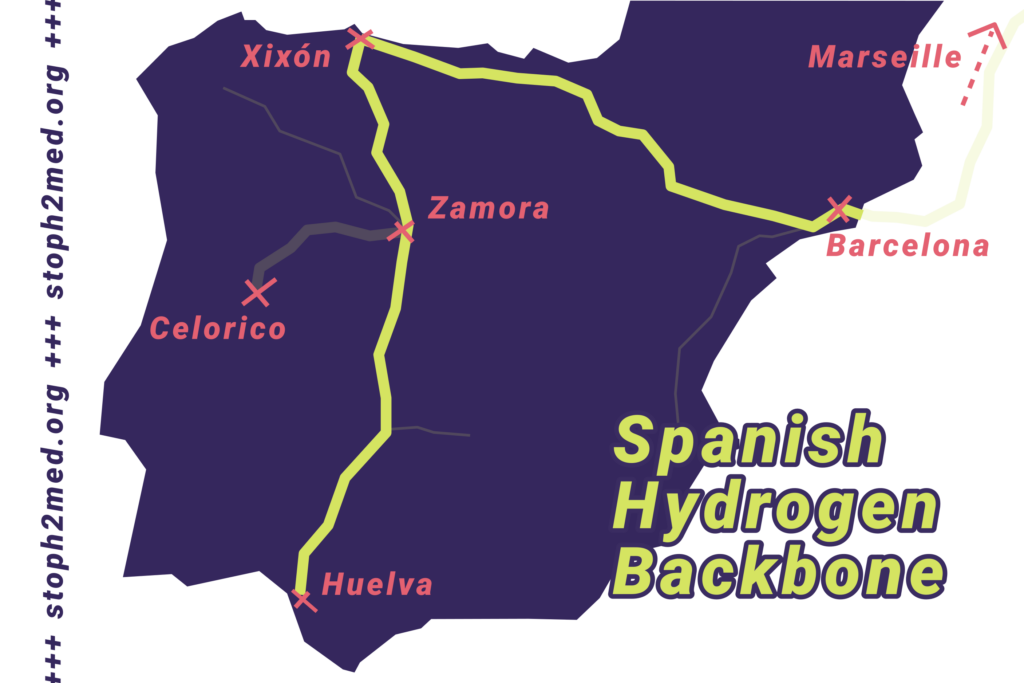
More information: Enagas, Ecologistas en Acción
The H2Med project includes all cross-border pipelines between Portugal, Spain, and France, allowing to export energy from the Iberian Peninsula to northwest Europe and mainly to western Germany with its steel and weapons manufacturing. Administratively, the ‘Spanish Hydrogen Backbone’ and ‘H2Med’ are two distinct projects. In practice, however, both are equally indispensable for the energy extraction plans and treated as equal here. Local activists, environmental groups, engineers, and energy-economy experts are alarmed by the proposed plans. The H2Med would…
- undermine the energy transition in Portugal and Spain, as the massive necessary roll-out of renewable energy projects, wrecks any efforts of a territorially, environmentally and socially just energy transition.
- direct public funds – aimed at infrastructure development and for the fight of the climate crisis – directly in the hands of multinational corporations, building another oversized gas system that no one needs and of which communities in energy producing regions don’t profit.
- serve as a ‘trojan horse’ for fossil gas. As there will not be enough hydrogen available to fill this oversized pipeline, blending hydrogen and fossil gas will serve as a strategy to sustain the pipeline investment and as an extension of fossil gas fracking, import, and transport.
- not be an efficient way of transporting. During the long-distance transport of ‘green’ hydrogen significant energy losses occur at each stage of the process from electrolysis, compression, and sending. A gas power plant running on 100% ‘green’ hydrogen consumes around 3x the energy it produces. Strictly prioritizing local ‘green’ hydrogen production and consumption is more efficient, especially for hard-to-electrify sectors like socially necessary steel production (e.g. public infrastructure).
- rely of huge amount of renewable energy production (40 GW) and water extraction (25-32 l/kg). The large-scale development could have significant impacts on ecosystems and communities.
More information: ZERO and Gas No Es Solución Network, ODG, Ecologistas en Acción, Global Energy Monitor
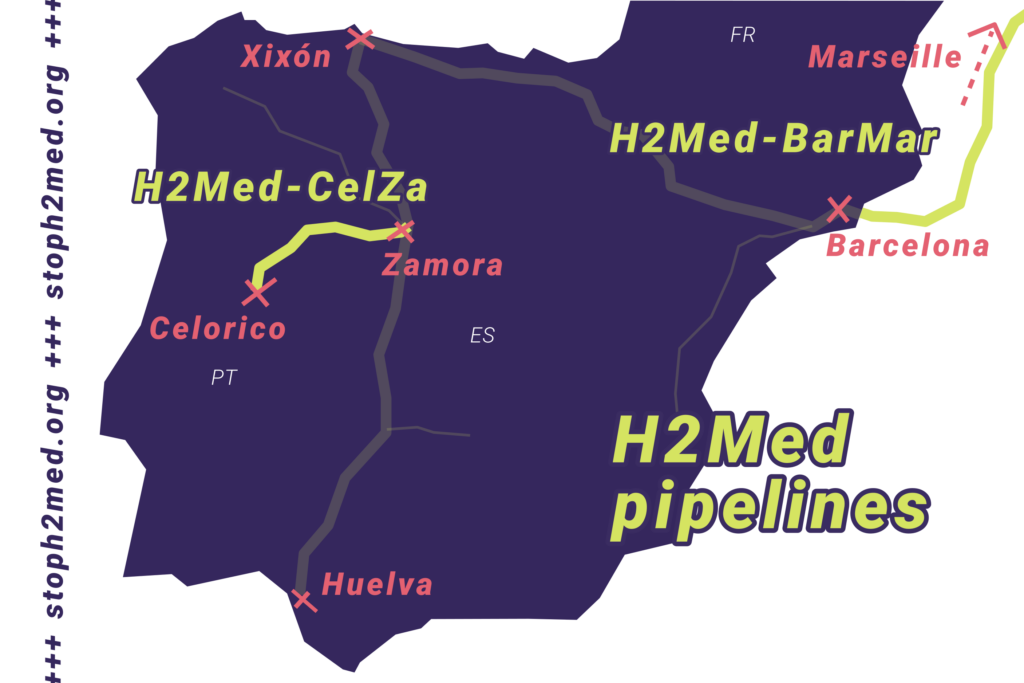
More information: Global Energy Monitor,
Actors and Conflicts
The Observatory of Debt in Globalization (ODG) is a research and campaigning organisation based in Catalonia. Since 2000 it has produced critical analysis on debt, climate justice, energy systems, ecofeminism, and the commons.
ODG combines research, public education, advocacy, and movement collaboration. It has become an important voice challenging greenwashing and exposing how corporate energy transitions reproduce inequality.
For movements confronting hydrogen mega projects, ODG is a valuable source of rigorous and accessible counter knowledge.
More information: odg.cat
Enagás is Spain’s gas transmission system operator and one of the central corporate actors driving the hydrogen pipeline agenda. Historically tied to fossil gas infrastructure, the company now presents itself as a key actor of the green transition through hydrogen networks and cross border corridors such as H2Med.
This repositioning is strategic. As gas demand faces long term decline, hydrogen offers a pathway to preserve infrastructure relevance, secure public funding, and extend the life of pipeline based business models. Existing assets, regulatory influence, and technical expertise give Enagás a strong role in shaping transition policy.
Critics argue this creates a conflict of interest. Companies that benefited from the fossil model are now leading the design of its supposed replacement. Rather than democratic energy planning, hydrogen networks risk being simply continuity of the old system painted in green.
More Concepts, Ideas, terms to know
Ancillary infrastructure refers to the supporting systems that are built in preparation for so called “main” infrastructure projects. In hydrogen development this includes access roads, grid connections, water extraction and concession systems, biogas facilities, and preliminary pipeline links that make large scale hydrogen production and transport possible.
Although often presented as secondary, these infrastructures are essential because they enable the future hydrogen system before it exists in full form. They already reshape land use, resource access, and territorial planning, often locking regions into long term industrial pathways.
Understanding ancillary infrastructure makes visible that hydrogen projects do not begin with pipelines or electrolysers, but with a gradual and material restructuring of space in advance of the promised “hydrogen future”.
Academic literature: Greiner and Klagge 2024